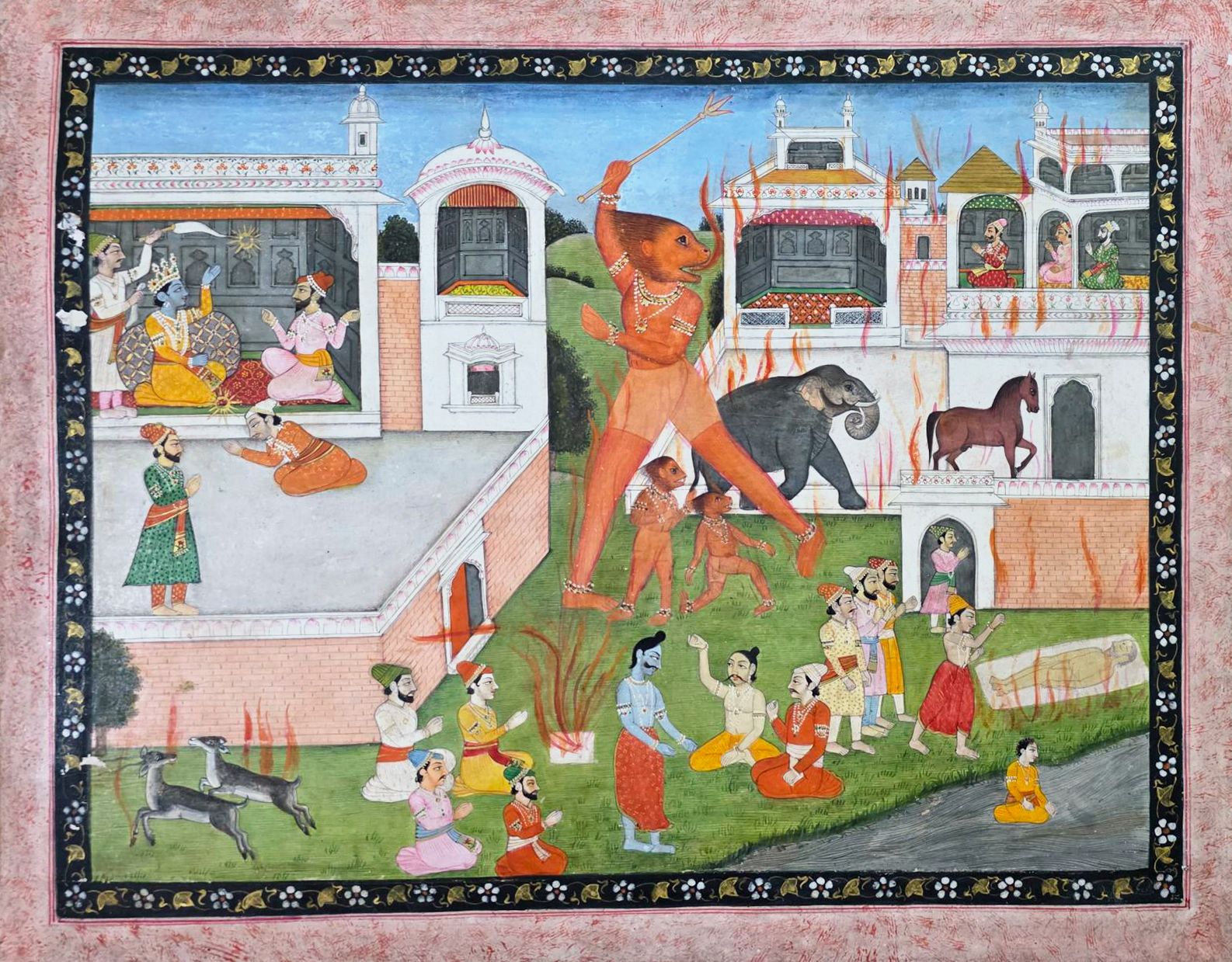
Lot 307 AN ILLUSTRATION FROM A BHAGWAD PURANA, KANGRA, PUNJAB HILLS, 19TH CENTURY
30 by 38 cm.
This vibrant Kangra school miniature, painted in opaque watercolors with gold accents on paper, captures a dramatic episode from the Bhagavata Purana (Book 7) illustrating the triumph of divine intervention over tyranny. In the classic Narasimha legend, the demon king Hiranyakashipu receives a boon making him nearly invincible—unslayable by man or beast, indoors or outdoors, day or night. When he persecutes his devout son Prahlada for worshiping Vishnu, the god manifests as Narasimha (half-man, half-lion) to circumvent the boon and restore dharma.In this dynamic composition, the ferocious orange-red Narasimha—with a lion’s head, muscular human body adorned in pearls and ornaments, and clawed hands—dominates the center. He appears in a powerful, leaping or striding pose, wielding a weapon (possibly a mace or trident-like form) amid flames engulfing the palace structures. The scene expands beyond the classic pillar-emergence and lap-slaying of Hiranyakashipu to show the broader chaos of divine wrath: the palace burns with red-orange flames licking at doorways and walls, while terrified demons and attendants flee or fall in disarray across the green foreground. A dark elephant and a brown horse add to the tumult, possibly symbolizing the king’s royal or military assets now in panic. Above and to the left, additional figures—including a blue-skinned divine or royal personage (likely representing Vishnu’s presence or a related form) and courtly attendants in colorful Pahari-style attire—observe or react from terraces and windows. The background features architectural elements typical of Kangra paintings: multi-tiered white and brick buildings with arched doorways, pillared verandas, and a distant temple-like structure, all rendered with delicate detailing and a sense of spatial depth. The composition uses the characteristic Kangra palette—soft greens for the landscape, vibrant reds and oranges for drama, and intricate black borders with floral and bird motifs framing the scene.Kangra miniatures (late 18th to 19th century, from the Pahari hill states of Himachal Pradesh) are renowned for their lyrical refinement, emotional expressiveness, and naturalistic yet stylized treatment of figures and landscapes. This work exemplifies the school’s narrative vigor in mythological scenes, blending intense action with refined brushwork. The pinkish outer mount and decorative border suggest it was prepared for collection or display. Such paintings often formed part of larger Bhagavata Purana or Dashavatara series, emphasizing themes of devotion (bhakti) triumphing over ego and adharma.