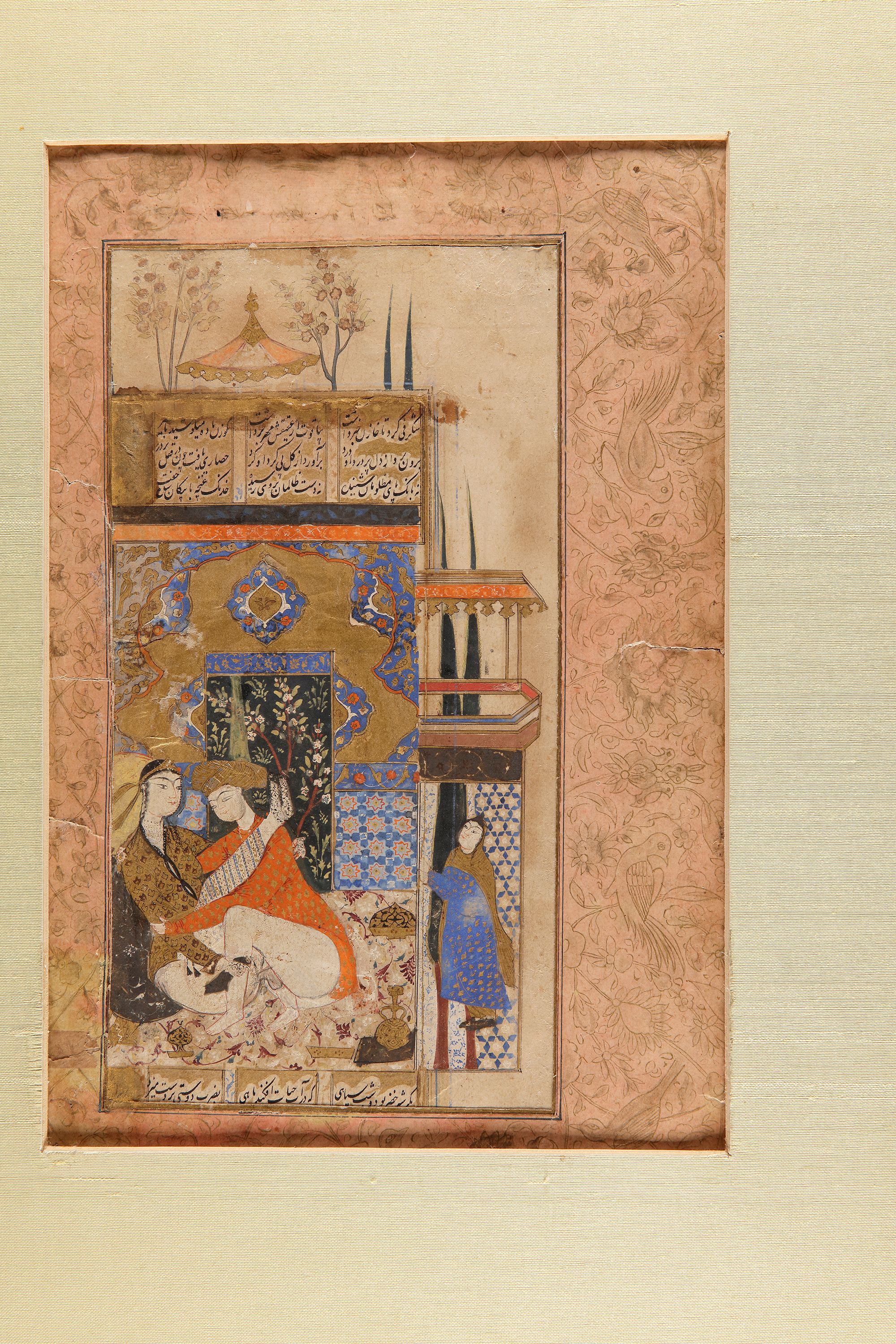
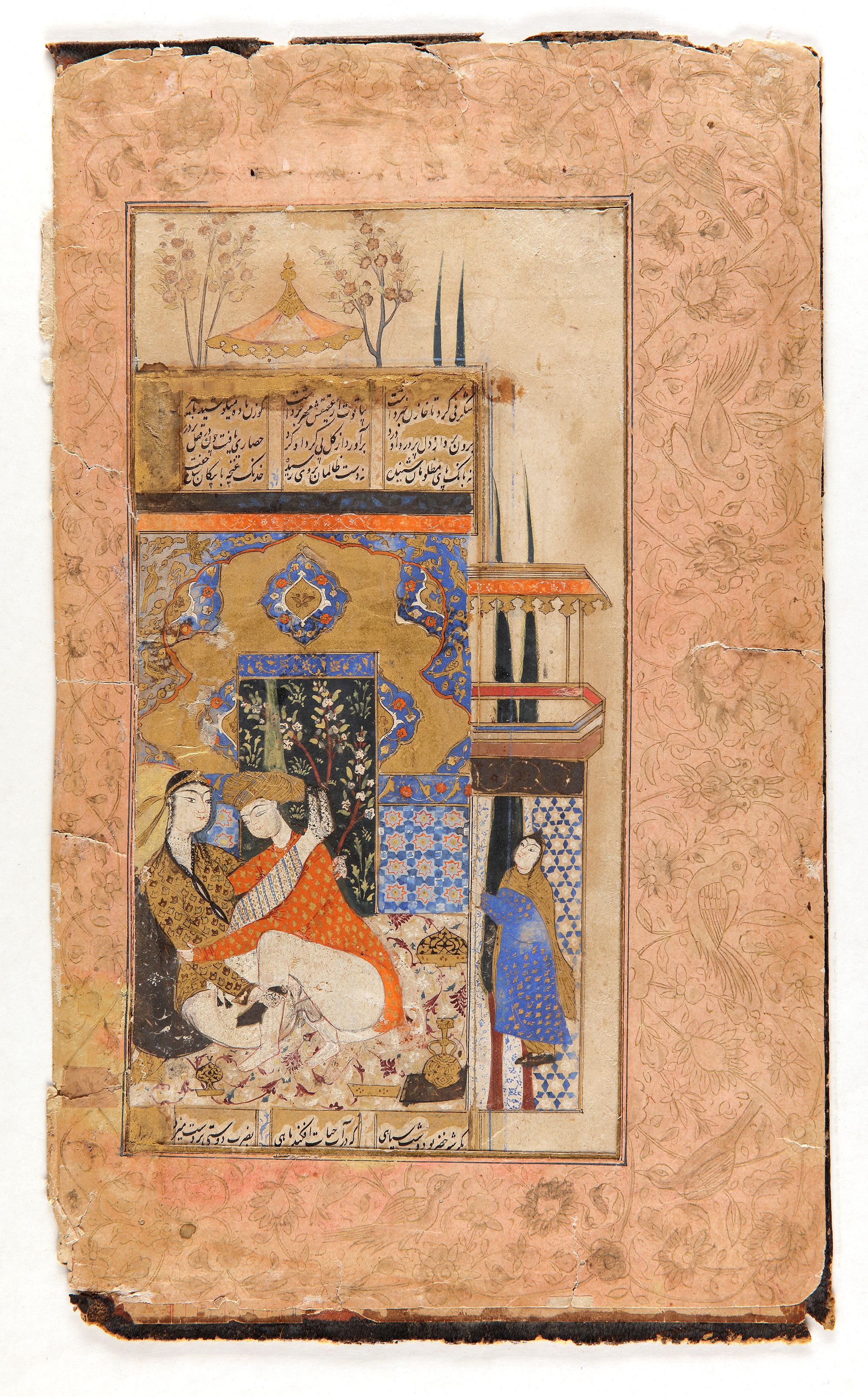
Lot 296 COURTLY LOVERS IN A TILED CHAMBER, ATTRIBUTED TO MUIN MUSAVVIR ISFAHAN, MID–LATE 17TH CENTURY
Opaque watercolor, ink, and gold on paper.
A single folio from a dispersed manuscript, later mounted as an album page (muraqqaʿ), depicts an intimate courtly encounter within a richly ornamented architectural interior. A young couple sits closely together on a patterned carpet.
To the right, a secondary figure, likely a servant or confidante, peers into the chamber from a doorway framed by blue-and-white tilework.
The background is enriched with stylized vegetal ornament, while the surrounding margins are lavishly illuminated with scrolling floral designs interspersed with birds, executed in pale ink and wash.
Above the scene, panels of Persian poetry in nastaʿlīq script are arranged in columns. The folio has been remounted, probably in the context of a later muraqqaʿ (album), as suggested by the decorated borders.
28 by 19 cm.
Catalogue note: The present work may be attributed to Muin Musavvir or his immediate workshop, on the basis of its figural style, linear refinement, and thematic sensibility, all consistent with painting in mid–17th-century Isfahan. The figures are characterized by softly modeled oval faces, elongated almond-shaped eyes, and finely drawn, continuous brows, rendered with a controlled and economical contour line. Their subdued, introspective expressions,conveyed through gesture rather than overt facial animation, closely align with the mature style of Muin Musavvir. Particular attention may be drawn to the treatment of the hands, whose tapering fingers and delicate articulation exemplify the artist’s refined linear technique. The emphasis on a private, courtly encounter, rendered with psychological restraint, reflects a pictorial mode developed in the circle of Reza Abbasi and continued by Muin Musavvir. The inclusion of a discreet attendant figure at the threshold further enhances the narrative sophistication of the composition, a device encountered in later Safavid painting. Equally significant is the handling of textiles and surface ornament, in which patterned garments and carpets are articulated with precision and clarity, privileging decorative rhythm over volumetric modeling. The harmonious palette and balance between figural and ornamental elements are characteristic of the refined aesthetic of the Isfahan school in the mid-17th century.
While the composition, structured vertically and integrated with text panels, reflects its origin as a manuscript illustration, minor variations in the fluidity of line suggest the possibility of atelier participation, a common feature of production in Muin Musavvir’s milieu. Nevertheless, the overall stylistic coherence supports attribution to the artist or a painter working in close proximity to him.