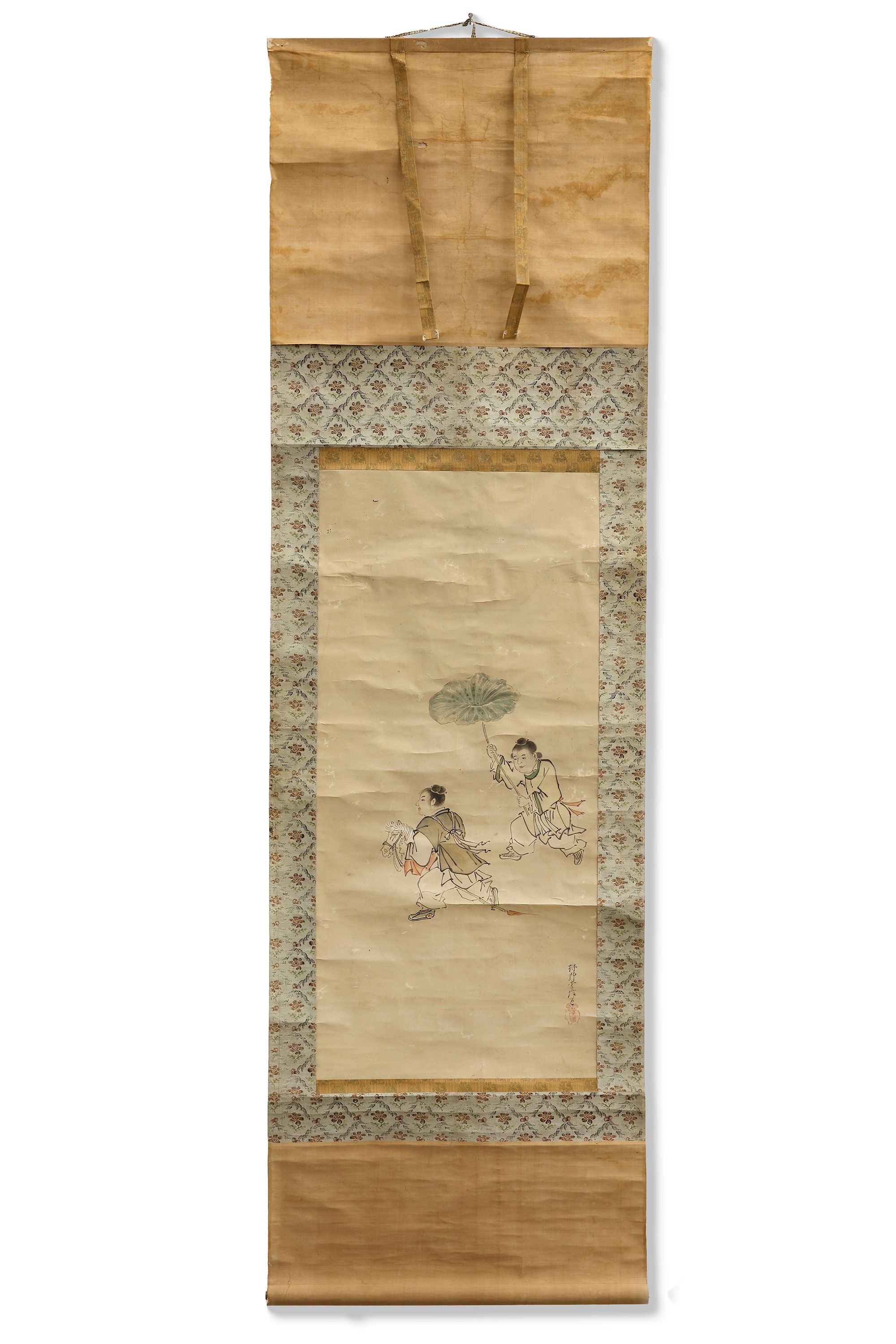
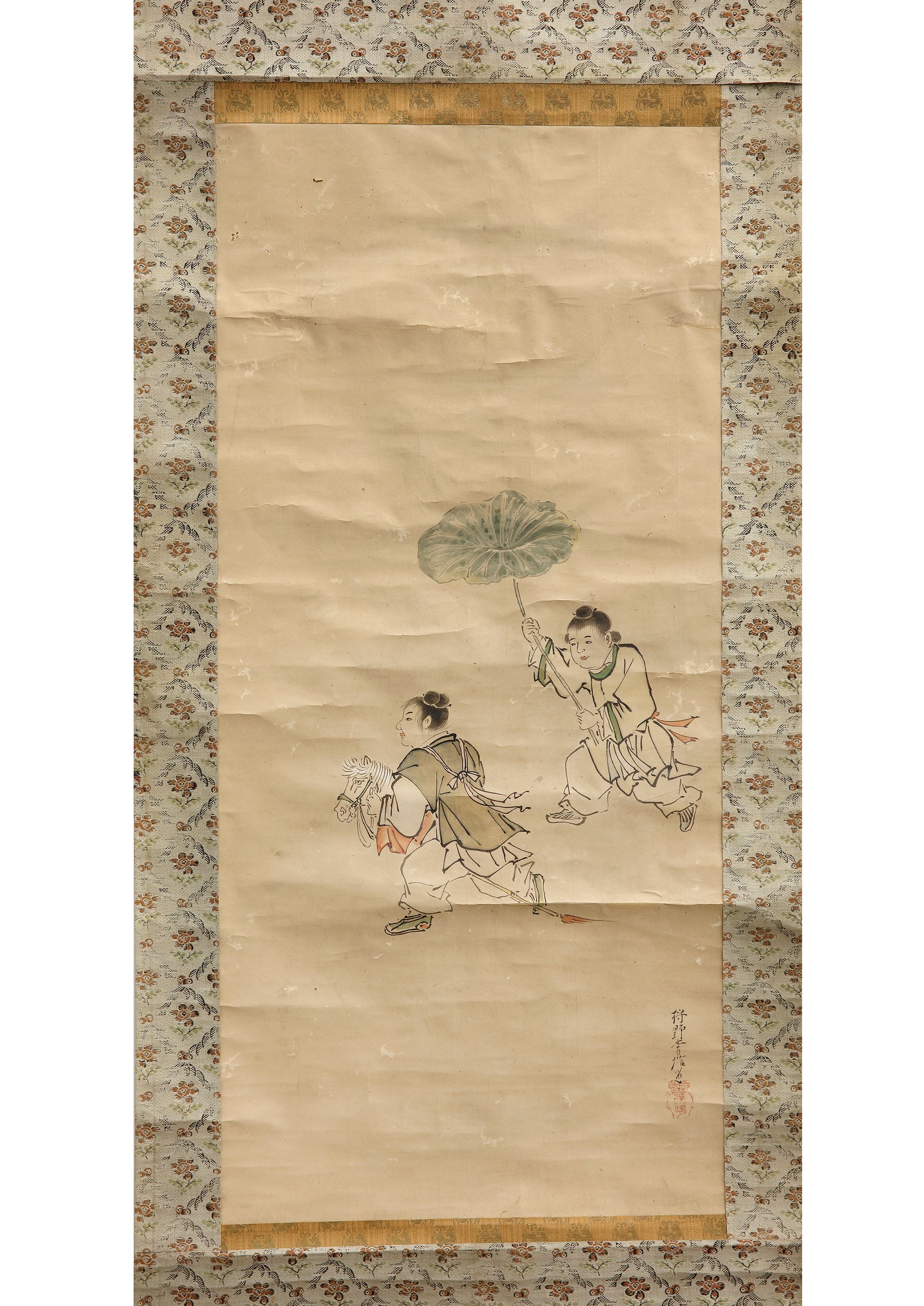
Lot 791 A JAPANESE HANGING SCROLL OF PLAYING CHILDREN, KANO TSUNENOBU
Kanō Tsunenobu (Japanese: 狩野 常信, pseudonyms: Yōboku (養朴), Seihakusai (青白斎), Kosensō (古
川叟), Kōkansai (耕寛斎), commonly known as Ukon (右近); born 18 April 1636, in Edo; died 21 February 1713) was
a Japanese painter of the Kanō school during the early Edo period and the second head of the Kobikichō branch.
Tsunenobu was the eldest son of Kanō Naonobu and, following his father’s death in 1650, took over the
leadership of the Kobikichō branch of the Kanō school.
He was involved in the decoration of the Imperial Palace in Kyoto with folding screens and wall paintings (障壁画, Shōheki-ga) during the Shōō (1652–1654),
Kambun (1661–1672) and Empō periods (1673–1680). When building works were carried out during the Hōei period
(1704–1710), he was entrusted with the execution of the sliding door paintings (襖絵, Fusuma-e) on the theme of ‘The Great and the Wise’ (拳聖, Kensei).
In 1704, Tsunenobu was awarded the honorary title ‘Hōgen’ and, in 1709, the title Hōin. His sketches of famous paintings,
known as ‘Tsunenobu shukuzu’ (常信縮図), are, together with similar sketches by Kanō Tan’yū, a valuable source for the study of Japanese art. Tsunenobu died at the age of 77 and was buried at Hommon-ji in Ikegami, on the outskirts of Edo.
81 by 38 cm.
Total size 165 by 50 cm.
Weight: 260g. Hand-painted on paper; the ends of the scroll are missing.